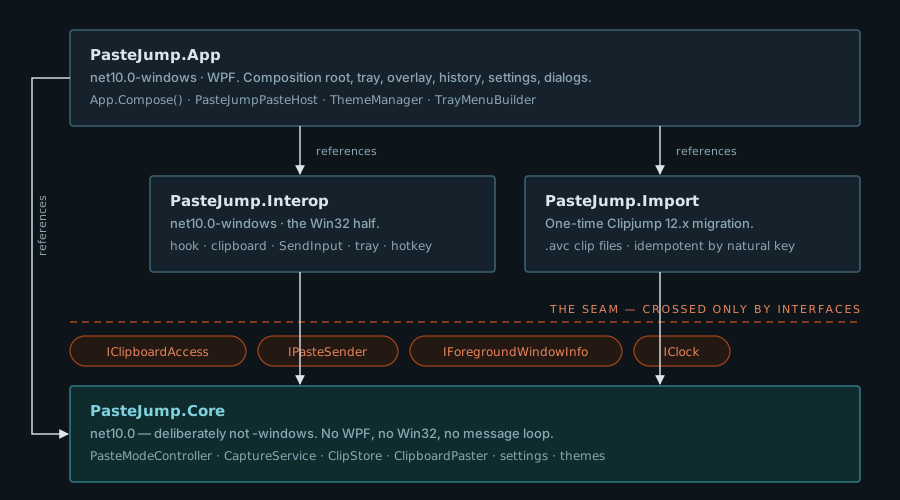
Seven views of one machine: the layers, the components, the classes, the two sequences that matter, the session state, the store, and the thread budget that shapes all of it.
There are two copies of this document and they must be edited together. This Markdown is what GitHub renders (mermaid diagrams and all);
architecture.htmlis the same content styled for the website, where it reads as one designed page, and the two hand-drawn figures indocs/images/are shared by both. Prose changes belong in both files in the same commit — unlikedocs/manual, nothing generates one from the other.Design rationale lives in
CLAUDE.md(the landmine sections) andPLAN.md(the state-machine spec). This document is the map, not the reasoning.
| Platform | .NET 10, WPF, win-x64 |
| Projects | 4 |
| Tests | 1,071 Debug · 1,069 Release |
| Version | 2026.1.0.n, where n is the commit count |
Contents
Hold Ctrl, tap V, let go. Every tap steps one clip further back through the stack, the overlay follows under your cursor, and releasing Ctrl pastes whatever is showing. No window to click, no mouse, no focus change. That gesture is the product, and three of its properties dictate the entire architecture.
The keyboard hook is machine-wide and on a deadline. A WH_KEYBOARD_LL callback blocks every keystroke on
the computer until it returns, and Windows silently discards a hook that outlives LowLevelHooksTimeout —
leaving an app that looks healthy and has gone deaf. So nothing in the callback sleeps, prompts, parses or
draws; it decides, queues, and returns.
Swallowing a keystroke takes it away from everyone. With no session open, exactly one chord is consumed —
Ctrl plus the trigger — and nothing else, swept over all 256 virtual keys in every modifier state by
IdleKeyboardTests. With a session open the gesture owns the keyboard except Alt and Win chords, which stay
with the shell so Alt+Tab is always the way out.
An empty store must not break Ctrl+V. The hook swallows the chord to build the gesture, so a store with
nothing in it hands the keystroke straight back as a native paste (PasteCommitKind.PassedThrough). Silently
breaking Ctrl+V system-wide is the worst thing this application could do.
The rule that follows from all three.
PasteJump.Corereferences neither WPF nor Win32 and never needs a message loop. Win32 access is expressed as interfaces inCore/Abstractionsand implemented inInterop. Anything that lands somewhere untestable gets moved, not covered by a UI test — which is why the capture service and the whole state machine are plain classes with 997 tests around them.
Dependencies point one way only. Core is the floor: it knows about clips, sessions and settings, and nothing
about windows or the operating system. Everything the OS provides arrives through four small interfaces, which
is also what lets tests drive the machine with a fake clipboard and no keyboard at all.
Dependencies point down, never up. Interop implements what Core declares, so the same state machine runs
against a real clipboard in the app and a scripted one in tests. Build output lands in artifacts/, never
under src/.
| Project | Framework | Holds |
|---|---|---|
PasteJump.Core |
net10.0 |
Domain logic. The state machine, capture, the store, settings, themes, formatters. |
PasteJump.Interop |
net10.0-windows |
Win32 implementations of Core’s abstractions, plus the hook, tray, hotkey and message-only window. |
PasteJump.Import |
net10.0 |
One-time Clipjump 12.x history migration. |
PasteJump.App |
net10.0-windows |
WPF. The composition root and every window. |
PasteJump has no main window. Everything starts from one of four operating-system events, and App.Compose()
wires the objects that handle them by hand — about a dozen with fixed lifetimes, so a DI container would add
indirection and remove nothing.
flowchart TB
  subgraph OS["Windows"]
    KEY["Keystroke"]
    CLIP["Clipboard change"]
    HOT["Registered hotkey"]
    TRAY["Tray click"]
  end

  subgraph IO["PasteJump.Interop — Win32 adapters"]
    HOOK["LowLevelKeyboardHook<br/>WH_KEYBOARD_LL"]
    MSGW["MessageOnlyWindow<br/>HWND_MESSAGE"]
    MON["ClipboardMonitor<br/>AddClipboardFormatListener"]
    HK["GlobalHotkey<br/>RegisterHotKey + MOD_NOREPEAT"]
    TI["TrayIcon"]
    VKT["VirtualKeyTranslator"]
    CBA["Win32ClipboardAccess"]
    SND["InputSender<br/>SendInput + real scan code"]
    FG["ForegroundWindowInfo"]
  end

  subgraph CORE["PasteJump.Core — decisions"]
    REC["PasteGestureRecognizer<br/>what to swallow"]
    CTL["PasteModeController<br/>the session"]
    CAP["CaptureService<br/>settle, guard, store"]
    GUARD["SelfWriteGuard"]
    PST["ClipboardPaster<br/>write then keystroke"]
    STORE["ClipStore + BlobStore<br/>SQLite + deflate"]
  end

  subgraph APP["PasteJump.App — WPF"]
    HOST["PasteJumpPasteHost<br/>IPasteModeHost"]
    OVL["OverlayWindow"]
    HIST["HistoryWindow"]
    TOAST["ToastWindow"]
    MENU["TrayMenuBuilder"]
  end

  KEY --> HOOK
  CLIP --> MSGW
  HOT --> MSGW
  TRAY --> MSGW
  MSGW --> MON
  MSGW --> HK
  MSGW --> TI

  HOOK -->|"KeyboardHookEvent"| VKT
  VKT -->|"GestureKey"| REC
  REC -->|"actions"| CTL
  CTL -->|"IPasteModeHost"| HOST
  CTL -->|"IClipCatalog"| STORE
  HOST -->|"BeginInvoke"| OVL
  HOST --> PST
  PST -->|"NoteWrite SelfWriteKey"| GUARD
  PST -->|"TryWrite"| CBA
  PST -->|"SendPaste"| SND
  PST -->|"settle delay per app"| FG

  MON -->|"OnClipboardChanged"| CAP
  CAP -->|"TryRead"| CBA
  CAP -->|"IsOwnWrite"| GUARD
  CAP -->|"Add + RecordHistory"| STORE
  CAP -->|"ClipCaptured"| TOAST
  CAP -->|"NotifyClipCaptured"| CTL

  HK -->|"Pressed"| HIST
  TI -->|"Activated"| MENU
  HIST --> STORE
Two independent paths, and that asymmetry is diagnostic. Capture rides WM_CLIPBOARDUPDATE, which no other
process’s hook can suppress; the gesture rides the keyboard hook, which any hook earlier in the chain can. When
copying works and pasting does not, a rival clipboard manager eating the injected keystroke is the first suspect
— hence the configurable PasteKeystroke.
The gesture is split in two on purpose. PasteGestureRecognizer answers only “is this keystroke mine, and
what does it mean”; PasteModeController owns the session — the window of clips, the cursor, the commit mode,
the marks — and performs no side effect itself. Everything it wants doing goes through IPasteModeHost, which
is what makes a paste testable without a clipboard.
classDiagram
  direction TB

  class PasteGestureRecognizer {
    +bool CtrlHeld
    +bool AltHeld
    +bool WinHeld
    +bool ShiftHeld
    +int MissedControlReleaseCount
    +Handle(GestureKey, isDown) bool
    +HandleCharacter(char) bool
    +ShouldSwallowUnhandled() bool
    +Reset()
  }

  class PasteModeController {
    +PasteSessionState State
    +PasteCommitMode CommitMode
    +Clip Current
    +Begin() PasteCommitKind
    +Handle(PasteAction) PasteCommitKind
    +HandleDigit(int) PasteCommitKind
    +SetSearchQuery(string)
    +ModifierReleased() PasteCommitKind
    +Abort() PasteCommitKind
    +NotifyClipCaptured()
  }

  class IPasteModeHost {
    <<interface>>
    +SnapshotExistingClipboard()
    +RestoreExistingClipboard()
    +PasteClip(Clip, IClipFormatter)
    +PasteJoined(clips, IClipFormatter)
    +PassThroughPaste()
    +ShowOverlay(PasteOverlayModel)
    +HideOverlay()
    +RequestDeleteAllConfirmation(int, Action)
    +NoteClipDeleted()
  }

  class IClipCatalog {
    <<interface>>
    +Snapshot() Clip[]
    +Delete(long)
    +DeleteAllUnpinned()
    +SetPinned(long, bool)
    +MoveToFront(long)
  }

  class PasteOverlayModel {
    +long ClipId
    +int Position
    +int Total
    +string PreviewText
    +PasteCommitMode CommitMode
    +PasteKindFilter KindFilter
    +int MarkedCount
    +bool PopOnPaste
  }

  class PasteJumpPasteHost {
    -Dispatcher _dispatcher
    -ClipboardPaster _paster
    -IReadOnlyList~ClipPayload~ _savedClipboard
    +SetOverlayAnchor(x, y, PopupPosition)
  }

  class ClipboardPaster {
    +MaxWriteAttempts = 4
    +Write(payloads, thenPaste)
    +SendPasteOnly() bool
    -ResolveSettleDelay() TimeSpan
  }

  class PasteKeyMap {
    +ToAction(char) PasteAction
    +Parse(string) PasteKeyMap
    +Validate() bool
  }

  class ClipStoreCatalog

  PasteGestureRecognizer --> PasteModeController : drives
  PasteModeController --> IPasteModeHost : asks
  PasteModeController --> IClipCatalog : reads and mutates
  PasteModeController ..> PasteOverlayModel : renders one frame
  IPasteModeHost <|.. PasteJumpPasteHost
  IClipCatalog <|.. ClipStoreCatalog
  PasteJumpPasteHost --> ClipboardPaster : write then keystroke
  PasteGestureRecognizer ..> PasteKeyMap : letters are data
Nothing in the left column touches Windows. PasteOverlayModel is immutable and carries ClipId because
Position is a coordinate in the filtered window — resolving a clip by position once drew the wrong image
when a kind filter was on.
| Seam | Implemented by | Why it exists |
|---|---|---|
IClipboardAccess |
Win32ClipboardAccess |
Reads every format in one pass, with a bounded retry (~620 ms). The original spun on OpenClipboard forever, turning another app’s misbehaviour into a hang. |
IPasteSender |
InputSender |
SendInput with a real scan code and our own dwExtraInfo signature — that signature is how the hook ignores our injection without ignoring RDP, VMs or macro keyboards. |
IForegroundWindowInfo |
ForegroundWindowInfo |
Names the window being pasted into, so the settle delay can be per application and the ignore list can be checked before reading a password manager’s clipboard. |
IClipCatalog |
ClipStoreCatalog |
Keeps “delete all unpinned” as one rule in the store rather than restated by whoever draws the dialog. |
IPasteModeHost |
PasteJumpPasteHost |
Every side effect of the state machine, all of it queued onto the Dispatcher — the reason the controller can run inside a keyboard hook at all. |
An OLE writer announces its data object and renders it afterwards, so a single Ctrl+C raises two or more
WM_CLIPBOARDUPDATE messages with different sequence numbers — and a read landing between them sees eight
bytes of bookkeeping and no content. Every guard below exists because one of those readings was once stored as
a clip.
sequenceDiagram
  autonumber
  participant SRC as Source app
  participant WIN as Windows clipboard
  participant MON as ClipboardMonitor
  participant CAP as CaptureService
  participant CB as Win32ClipboardAccess
  participant SW as SelfWriteGuard
  participant ST as ClipStore
  participant UI as Toast / windows

  SRC->>WIN: Ctrl+C, OleSetClipboard then OleFlushClipboard
  WIN->>MON: WM_CLIPBOARDUPDATE
  MON->>CAP: OnClipboardChanged()
  CAP->>CAP: schedule read in ClipboardSettleMs, default 120 ms
  WIN->>MON: WM_CLIPBOARDUPDATE, the second step
  MON->>CAP: OnClipboardChanged()
  Note over CAP: Coalesced, and the window RESTARTS.<br/>Bounded at 4 extensions so an app<br/>rewriting on a timer cannot defer for ever.
  CAP->>CAP: sequence number moved? excluded process?
  CAP->>CB: TryRead()
  CB-->>CAP: ClipboardSnapshot: payloads, text, kind, hasOwner
  CAP->>SW: IsOwnWrite(snapshot.SelfWriteKey)
  SW-->>CAP: no, this is somebody else's copy
  CAP->>CAP: bookkeeping only? then retry, it is a half-written clipboard
  CAP->>CAP: same DedupKey as the last clip?
  ST->>ST: republish carrying MORE bytes: ReplacePayloads, silently
  CAP->>ST: Add(snapshot) then RecordHistory
  ST-->>CAP: Clip, wasNewCapture
  CAP->>UI: ClipCaptured
  UI->>UI: toast, beep, controller.NotifyClipCaptured()
The settle window restarts rather than expiring. A fixed window measured from the first notification was the
first attempt and produced a spurious “same as the last copy” toast whenever the second step landed just after
it. 120 ms was measured, not chosen: a WinForms SetImage holds the clipboard locked for ~50 ms and its
CF_DIB first reads at 51 ms.
| Guard | Budget | What it prevents |
|---|---|---|
| Settle window, restarting | 120 ms × 4 | One copy stored as two clips, or announced as a repeat of itself. |
| Sequence number unchanged | — | Paying to open the clipboard for a duplicate notification. |
| Excluded process, checked first | — | Pulling a password manager’s clipboard into memory before deciding to discard it. |
| Bookkeeping-only payloads | 2 retries, 350 ms | An 8-byte DataObject stored as a [binary] clip — and, worse, promoting an unrelated old blob to the front of the stack. |
IsOwnWrite(SelfWriteKey) |
5 s TTL | A paste being captured straight back as a new clip. Content-addressed, so there is no timing race. |
IsEchoOfOwnWrite |
1 s | The second notification for one paste falling through to the duplicate branch, which announces itself. |
| Owner is null | — | An app flushing its formats as it closes reading as a fresh copy. Only ownership tells that from a repeat. |
RedundantImageFormats.Prune |
~⅔ of bytes | Keeping the same pixels three times as CF_DIB, CF_DIBV5 and System.Drawing.Bitmap. |
This is the whole product in one diagram. Note where the work happens: the hook thread decides and returns, and
every consequence — the overlay, the clipboard write, the keystroke — runs on the UI thread through
Dispatcher.BeginInvoke. Note also the last two messages: our own paste comes back round as a clipboard change,
and the capture path has to recognise it. That return edge is where the bug in the case study lived.
sequenceDiagram
  autonumber
  participant U as You
  participant HK as Hook thread
  participant REC as Recognizer
  participant CTL as Controller
  participant H as Paste host, UI thread
  participant OV as OverlayWindow
  participant W as Windows
  participant CAP as CaptureService

  U->>HK: Ctrl down
  HK->>REC: Handle(Control, down)
  REC-->>HK: not swallowed, the app underneath tracks Ctrl too

  U->>HK: V down
  HK->>HK: read Ctrl, Alt, Win, Shift LIVE via GetAsyncKeyState
  HK->>REC: Handle(Paste, down)
  REC->>CTL: Begin()
  CTL->>H: SnapshotExistingClipboard()
  CTL->>CTL: RefreshWindow(), kind filter then search query
  alt store is empty
    CTL->>H: PassThroughPaste()
    Note over CTL,H: PassedThrough. Never swallow Ctrl+V<br/>when there is nothing to offer.
  else clips available
    CTL->>H: ShowOverlay(PasteOverlayModel)
    H->>OV: BeginInvoke: place and show
    OV->>W: caret, else foreground centre, else corner if topmost
  end
  REC-->>HK: swallowed, so the app never sees the V

  U->>HK: V again, and again
  HK->>CTL: Advance, then Render, then ShowOverlay

  U->>HK: Ctrl up
  HK->>REC: Handle(Control, up)
  REC->>CTL: ModifierReleased()
  CTL->>CTL: Commit(): marks win, else suppressed by Delete, else current clip
  CTL->>H: PasteClip(clip, formatter)
  H->>H: BuildPayloads, apply formatter
  H->>H: NoteWrite(snapshot.SelfWriteKey)
  Note over H: Key the round trip, not the bytes:<br/>Windows refills CF_TEXT, CF_OEMTEXT and<br/>CF_LOCALE from the PASTING thread's locale.
  H->>W: TryWrite(payloads), up to 4 attempts
  W-->>H: written
  H->>H: wait the settle delay for this app, default 25 ms
  H->>W: SendInput: Ctrl+V, or Shift+Insert
  W->>U: the application pastes
  W->>CAP: WM_CLIPBOARDUPDATE, our own write coming back
  CAP->>CAP: IsOwnWrite(SelfWriteKey): skipped, no clip, no toast
Never send the keystroke unless the write succeeded. Clipboard writes genuinely fail — it is a machine-wide
lock — and a Ctrl+V after a failed write pastes whatever was there before, which looks exactly like PasteJump
choosing the wrong clip. That ordering lives in Core precisely so it can be tested.
The commit is not one branch. Marks beat the cursor, a Delete during the session suppresses the paste
entirely, and the X cycle can arm something destructive — which is why the only irreversible outcome asks
first, and asks asynchronously, because a modal dialog inside the hook would block every keystroke on the
machine.
PasteCommitKind |
Reached when | What the user sees |
|---|---|---|
Pasted |
Mode is Paste and a clip or a set of marks exists | The clip arrives; with Shift held it is also deleted (“pop”). |
PassedThrough |
Empty store, emptied window, or every mark deleted | A native Ctrl+V. Nothing of ours happened. |
Cancelled |
Esc, mode is Cancel, or Delete was pressed this session |
Clipboard restored, nothing pasted. |
Deleted |
Mode is Delete | Current clip gone, clipboard restored. |
DeleteAllRequested |
Mode is DeleteAll | A confirmation, later, on the UI thread. Nothing has been deleted yet. |
PushedToClipboard |
S |
Clip is on the clipboard; no keystroke sent. |
None |
Stepping, searching, pinning, marking, deleting one clip | Session stays open. |
In Browsing, holding Ctrl is what keeps the session alive and releasing it commits. In Searching that would
be unusable — you need both hands to type — so releasing Ctrl does nothing at all and the session ends
explicitly with Enter or Escape. While the search box is up, no letter and no digit is an action: the arrows
are the only way to step, because they are the one pair that can never be part of a query.
L generalises that freedom to browsing. A locked session is still Browsing - the lock is a flag rather
than a fourth state, since search and lock are independent - but RequiresModifier is false, so the Ctrl release
commits nothing and every key goes on acting. One property answers it for all four callers that ask: the commit,
the action gate, the missed-release reconciliation and the health watchdog. Unlocking is refused unless Ctrl is
held, or the session could be left neither locked nor held open, accepting no key but Escape while swallowing
every one of them.
stateDiagram-v2
  direction LR
  [*] --> Idle
  Idle --> Browsing : Ctrl + trigger, and NO Alt, Win or Shift
  Idle --> Idle : trigger alone, or any other key, passes through
  Browsing --> Browsing : trigger steps older, arrows, digits, Home, End
  Browsing --> Browsing : K kind filter, Z formatter, X commit cycle, J mark
  Browsing --> Searching : F
  Searching --> Browsing : Ctrl + F closes the box
  Searching --> Idle : Enter commits, Esc aborts
  Browsing --> Browsing : L locks - Ctrl stops holding the session open
  Browsing --> Browsing : ? lists every key in the overlay
  Browsing --> Idle : Ctrl up commits, unless locked
  Browsing --> Browsing : Enter pastes and keeps the session open
  Browsing --> Idle : Esc aborts, clipboard restored
  Browsing --> Idle : H, O, T, E, F1 end the session, then open a window
  Browsing --> Idle : Y types the clip out, clipboard untouched
  Browsing --> Idle : Ctrl release never seen and NOT locked, session ABORTED
Anything that opens a window must end the session first. F1 once did not, so the key card appeared over a
live overlay that went on swallowing the very keys it was explaining. The last edge is the watchdog: a missed
Ctrl-up is aborted rather than committed, because releasing Ctrl is what asks for a paste and here we do not
know that the user did.
The X cycle runs Paste → Cancel → Delete → DeleteAll → Cancel and never returns to Paste — deliberate
parity with the original, since a destructive cycle that looped back through “paste” would make an over-eager
keypress paste something you were trying to delete. The kind filter, by contrast, does wrap: nothing there is
destructive, so getting back to seeing everything must not cost three more taps.
Immutable ids plus a fractional sort_key, so repositioning a pinned clip is one UPDATE — in the original it
was three FileMove calls per clip across parallel directories. The stack and the archive are separate tables
on purpose: a clip is a thing to paste and gets evicted; a history row is a record of when something was copied
and gets pruned by age.
erDiagram
  clip ||--o{ clip_format : "one row per clipboard format"
  clip ||--o{ clip_tag : "tagged"
  tag  ||--o{ clip_tag : "applied to clips"
  history ||--|| history_fts : "FTS5, external content"
  clip {
    INTEGER id PK
    REAL sort_key "fractional, pinned first"
    INTEGER pinned
    TEXT preview "capped at PreviewMaxChars"
    INTEGER kind "Text Image Files Other"
    TEXT source_exe
    INTEGER total_bytes
    TEXT content_hash "identity"
  }
  clip_format {
    INTEGER clip_id FK
    INTEGER format_id "re-registered by NAME on write"
    TEXT format_name
    BLOB data "small payloads inline"
    TEXT blob_hash "large payloads in blobs, deflated"
  }
  history {
    INTEGER id PK
    TEXT captured_utc
    TEXT preview "indexed by history_fts"
    TEXT blob_hash "full text beyond the preview cap"
    TEXT imported_from
  }
Format ids are not durable. Ids from RegisterClipboardFormat are stable only for the Windows session, so a
payload stores the name and is re-registered on write. Persisting the number alone would attach today’s bytes
to an unrelated format tomorrow.
| Key | Question | Covers | Consequence of getting it wrong |
|---|---|---|---|
ContentHash |
Is this the same clip? | Every format’s id, name and bytes. | It is a stored column and the lookup for enrichment. Too loose and two clips merge. |
DedupKey |
Did the user copy this again? | Trimmed text alone for text clips; the content hash otherwise. | Word and Excel stamp their rich formats with generator ids, so a bytes-exact key never fires and the stack fills with apparent duplicates. |
SelfWriteKey |
Is this clipboard ours? | Only the payloads Windows does not refill for itself. | Too tight and PasteJump captures its own paste as a new clip — see the case study. |
Read this figure as the reason for a dozen decisions elsewhere: why the trigger key and the letter map are
parsed once per settings change rather than per keystroke, why the delete-all prompt is a request rather than a
question, and why a Console.Beep — which blocks until the tone finishes — goes to the thread pool.
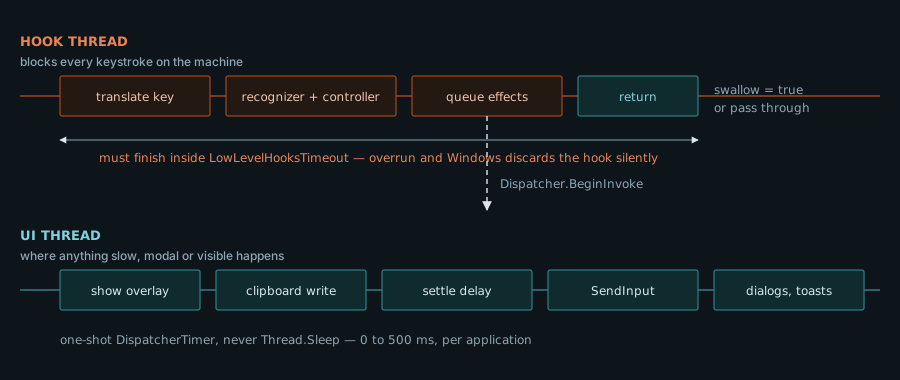
The hook decides; the Dispatcher does. A watchdog on a 250 ms timer covers the case where Windows drops the
hook anyway — and it cannot ask IsInstalled, because a discarded hook leaves that reporting true for ever.
It reasons from evidence instead: has anything been heard since Ctrl went down, and is a session still open
while Ctrl is physically up.
Reported 2026-08-21, fixed the same morning. “I pressed Ctrl+V in Edge and I saw the paste overlay, and immediately it displayed copy overlay also.”
Not a notification fault and nothing to do with Edge. Look at the last two messages of View 5: a paste comes back as a clipboard change, and it was not recognised as ours — so it was stored as a brand new clip and announced, exactly like any copy.
The live logs said so in one reading. logs\gesture.log has the commit (Ctrl up ... fg=msedge.exe at
07:55:37.305) and logs\capture.log has the read 135 ms later — STORED clip 3699 (new=True), where every
later paste of the same clip said skipped: this is our own write.
Two clips in the store held the same 66 characters, the same four formats and the same 2,044 bytes. They differed in a single byte pair.
| Clip | CF_LOCALE |
|
|---|---|---|
| 3698, as captured | 09 40 00 00 |
0x4009 — English (India), the layout the text was copied under. |
| 3699, as read back | 09 04 00 00 |
0x0409 — English (US), what Windows synthesised when it was pasted. |
A clipboard write does not read back as what was written. The writer deliberately drops CF_TEXT,
CF_OEMTEXT and CF_LOCALE when CF_UNICODETEXT is present, because a stale ANSI rendering captured under
another codepage can contradict the Unicode beside it and whichever the target app prefers decides what the user
gets. Windows then regenerates all three — from the pasting thread’s locale, not the copying application’s. So
the round trip is not the identity, and ContentHash, which covers every format’s bytes, could not match it.
Why it survived so long. It is self-limiting per clip. The recaptured twin carries the synthesised locale, so it is a fixed point and every later paste of that twin is recognised correctly. The log therefore reads like an intermittent fault — stored once, skipped twice — and a bug that stops reproducing on the second attempt is a bug that gets dismissed. It reappears for each newly captured clip, for ever.
Measured footprint on the reporting machine: 347 clips carry 0x4009 and 228 carry 0x0409, and eight of the ten largest same-text clip groups differ only in that byte. Those groups are paste-recaptures, not repeat copies — one duplicate clip and one history row per first paste, with the browse position reset each time.
ContentHash still identifies a clip and is untouched,
since those bytes really do differ. SelfWriteKey identifies a round trip: the same hash over the payloads
Windows does not refill. Where nothing is dropped it is ContentHash, so images, file lists and every
existing store are unaffected. — src/PasteJump.Core/Model/ClipboardSnapshot.csSynthesisedTextFormats.DropDerived is now called by both the write filter
and the identity key — one list, not two that can disagree, which is precisely this bug’s shape. —
src/PasteJump.Core/Model/SynthesisedTextFormats.csCF_TEXT keeps it: an empty payload set would
identify every such clip as the same one, and a paste would suppress the capture of an unrelated copy.tests/PasteJump.Core.Tests/SynthesisedTextFormatsTests.csThe transferable part. Three instruments answered this and none of them was reasoning: the gesture log gave the commit, the capture log gave the read, and the store gave the cause. When a capture question comes up again, query the database early — a format list and four bytes settled in minutes what an afternoon of plausible theories about Edge would not have.
PasteJump — keyboard-driven multiple clipboards for Windows, a ground-up reimplementation of
Clipjump from observed behaviour. Detail lives in CLAUDE.md (the
landmine sections), PLAN.md (design and the state-machine spec) and TASKS.md (what is open).